Showing posts with label Football. Show all posts

Tuesday, 31 August 2010

Football's noisy chasm: The case of Steve Coppell and why fans boo


When Steve Coppell announced his resignation after just two months as Bristol City manager, the surprise resonated far beyond the usual gawpings of radio phone-ins or rolling news channel banalities.

The esteemed former Reading boss was not only stepping down from his post at a bafflingly early stage, but retiring from football altogether.

And it was Coppell's reason for taking such decisive action which shocked commentators and fans most.

The 55-year-old explained how his fading passion for the game had left him devoid of inspiration, unmoved by the prospect of leading his Bristol City players for their second match of the season.

But while, for most, an element of detachment from one's work is a prerequisite for sanity; for football fans, a sense of distance or objectivity in relation to the sport is as attractive as a steak and kidney flapjack.

Coppell had enjoyed a successful managerial career, guiding Crystal Palace and Reading to the Premier League, and earning praise for the fluent, attacking style he instilled in his teams. So why, fans asked, would somebody turn their back on this ultimate profession?

The answer lies in the nature of that question's final word.

Throughout his playing and managerial career, Coppell maintained a sense of perspective; as enjoyable as football may be, it was for him simply a job.

Such an outlook is partly influenced by Coppell's playing days, ended by injury at the cruel young age of 28.

Having had his own dream job cut short, the former England international has an acute understanding of how football is but a profession. Life goes on without it.

It is this detachment, however, which causes the chasm ripping through the sport''s heart.

Beyond the vuvuzelas, the soundtrack of this summer's World Cup was the chorus of boos.

For the usually adored likes of Wayne Rooney and Frank Lampard, a tournament-long exhibition of mediocrity saw them drown under an inescapable din of boos.


The cries of fury in South Africa, however, were no different to the tunes of discontent which ring out of from British stadia on a weekly basis.

For every player who has his name chanted by thousands, there is one who feels the wrath of his club's followers, and it is not simply because a pass intended for a team-mate has ended up in the directors' lounge.

A miss-kick or a home defeat can sometimes be grudgingly accepted, but it is the manner of failure which irks fans most.

The passion of the underperforming players is questioned, their desire to win is shrouded in doubt, and their wages are (justifiably) criticised.

Further than the obvious alienation that stems from such a gross gap in pay, the division between players and fans is intrinsically linked to the bemusement supporters felt after Coppell's resignation.

For fans, there can be no sympathy for individuals who treat as a job what is for them a passion.

While the audience vicariously endures the drama of their club's season, the protagonists treat each match as a matinee, a day in the office.

But what might be just another afternoon's work for the players of this piece is for the paying onlookers an addiction.

For disgruntled season ticket holders, the players - to whose wages they make a significant contribution - are little more than mercenaries commodifying their purest form of entertainment.

So, armed with little more than their voices and cups of Bovril, the boo is for fans the most effective way of expressing their disgust; the most direct form of bypassing the chasm between players and supporters.

The season is but a few weeks old, yet terraces nationwide are already shaking with boos.

And should the cat calls or wolf whistles lead to another resignation or retirement, this chasm will only grow wider and louder.

Friday, 6 August 2010

Football's parallel universe


With the Premier League fast approaching, much media coverage revolves around the frenzied dealings of the transfer market. And although a plucky performance on a soggy pitch in Pontcanna is unlikely to attract a multi-million bid from Manchester City, amateurs in the parks league can rejoice in the fact that they too can move from club to club like an expensive professional.

While there are some who loyally stick with one team for years, those of a more fickle ilk can forge a journeying career with only the briefest of stays at any number of sides. Pre-season training is nearing its conclusion, and players across the leagues are ready to showcase their talent to a host of potential new clubs.

There are numerous stages for such displays, whether it is the hallowed turf of Trelai Park or Cwrt-Y-Vil’s home ground Llandough Fields. Changing rooms are infused with the smell of cigarettes and Deep Heat muscle rub, and the pitches themselves are a marshland of miss-kicks and the odd moment of brilliance.

This contrast is the primary appeal of parks football; a player is as likely to fire a match-winning volley as he is to be kicked into orbit by an overweight, middle-aged centre-back. Parks football is also intrinsically attractive for fans of the sport because it often seems to operate in a parallel universe to the professional game.

In the shadow of the Cardiff City Stadium, for example, lies a ground belonging to a different footballing sphere, Grange Albion’s Coronation Park. While 20,000 or so flock to see Cardiff compete for a place in the Premier League, a handful of fans walking across Sloper Road stop by to watch 22 less celebrated players vie for the bragging rights of an alternative top flight: the Cardiff and District Premier Division.

I’ve plied my trade with parks sides of varying quality, and although professionals now often seem to be younger than me, I still haven’t entirely abandoned my childhood ambition of playing in the Premier League. Arsene Wenger, however, has not yet been in contact.

As written for Guardian Cardiff

Monday, 12 July 2010

The World Cup: National Stereotype Bingo


Refreshing Ghanaians, industrious Koreans, flamboyant Brazilians, arrogant Frenchmen, negative Italians and efficient Germans.

While the World Cup may have deprived us of many things (daylight, the ability to form a non-football related conversation), the British media’s coverage of the tournament certainly provided us with an abundance of national stereotypes. Indeed, soundtracked by BBC or ITV commentary, watching an international football match became more like an introduction to a game of national stereotype bingo.

The opening fixture between hosts South Africa and Mexico set the tone, with Peter Drury rejoicing at the “wonderful sights and sounds” of a “colourful” crowd. This was, after all, the first World Cup to be staged in Africa, a continent supposedly without anything but a smile on its face.

It was Ghana who were truly smothered by patronising ITV commentary, with Clive Tyldsley particularly belittling in his reference to the Black Stars’ “refreshing” approach. With every mention of the “colour” and “big African smiles” of supporters and players alike, it was as if the entire squad were having their hair ruffled by an army of elderly relatives.

Ghana’s quarter-final loss to Uruguay was, of course, a crushing blow to the whole of little Africa, and our friends in the studios had the knives out for Luis Suarez, Uruguay’s willing pantomime villain. Suarez’s handball denied Ghana a semi-final place, helped big bad Uruguay (population of three million people) to a fourth-placed finish and allowed Adrian Chiles and his cronies to crank up the condescension with heaps of gushing sympathy.

South Korea were treated similarly even as they beat Greece 2-0, with analysts and pundits repeating like a mantra the now institutional stereotype of “industrious” Asian footballers. The guile of Park Ji-Sung was irrelevant, likewise South Korea’s collectively slick performance. What ITV wanted us to see was just how hard those little South Koreans had worked.


BBC were seldom any better on the opening day, as they indulged in predictable caricatures of the French squad. “Plenty of Gallic shrugs,” Steve Wilson helpfully observed, reminding those watching at home that Raymond Domenech’s men are little more than an assembly of ‘cheese-eating surrender-monkeys’.

With their self-destructive penchant for player coups and disinterested performances, though, France were arguably one team who actually strengthened their country’s stereotypes.

Brazil and Holland, meanwhile, were determined to confound their respective traditions of ‘Samba Football’ and ‘Total Football’ flamboyance. With every gruff holding midfielder who replaced a dainty playmaker, their managers Bert Van Marwijk and Dunga seemed to be revelling in their elaborate refusal of the long-standing labels attached to their sides.

Tyldsley did not appear to have seen any of Brazil’s matches, however, as he welcomed a headed goal of theirs with the disbelieving screech: “Brazil score a British goal!” How surprising that the diminutive South Americans can jump and emulate their Anglo-Saxon peers, who had of course enjoyed such a fruitful tournament.

England did seem conspicuous by their absence in these long and recurring lists of stereotypes. So, when BBC and ITV commentators present their warped coverage of Euro 2012, why not introduce their viewers to the “underwhelming English”?

Tuesday, 29 June 2010

The Not So Golden Generation


As the hysteria subsides and cries of injustice die away, England is coming to terms with the passing of what was supposedly a golden generation of footballers.

England’s 4-1 defeat to Germany was met with outrage and disbelief, and then a feeling that an entire country had been cruelly denied the glory which was rightfully theirs.

Commentators, journalists and fans alike were all incredulous that Germany had the temerity to spoil their party; overlooking how the Germans had assembled a side that plays some of the most confident, thrilling football in the world.

For once, it was not the odious players who truly soured the occasion, but the voyeuristic reaches of the media.

Frank Lampard accepted defeat manfully, and as he exchanged post-match pleasantries with Germany's excellent Bastian Schweinsteiger, there was in his weary gaze more than the distant look of a beaten man.

At 32, Lampard is a veteran English pin-up of the Premier League, and he – along with his other much-vaunted (and ultimately over-hyped) team-mates – saw this World Cup as a last shot at international immortality.

This potential glory was considered a divine right by others. The Sun boasted on their front page of England’s ‘E-A-S-Y’ group when the World Cup draw was made, and this sense of entitlement seeped through hordes of English media camped in South Africa.

The chest-beating red tops and rolling news channels were missing the point, though. Indeed, their reading of the situation was as far from reality as an Emile Heskey shot is from goal.


This, after all, was no golden generation. Since the halcyon days of a semi-final defeat in 1990, England have failed to qualify for two major tournaments and have twice been eliminated at the group stage. Golden indeed.

And even after England showed themselves to be distinctly mediocre in their plodding displays against the USA and Algeria, the media still could not fathom how a team as excellent as Germany’s could outclass their dear Three Lions so thoroughly.

England players were actually commendably mature in defeat, though the media glare around them was unrelenting. While Lampard and Steven Gerrard magnanimously accepted that they had simply been outplayed, the BBC’s Alan Hansen bleated about "average" Germans, and Sky's reporters beat the "we woz robbed" drum of self-pity deep into the Bloemfontein night.

This golden generation, we had been led to believe, simply required an alchemist to mould match-winners out of this mound of talent. Fabio Capello, a manager whose Midas touch is unquestioned at club level, was seen as the man to turn these underachievers into all-conquering champions. As this dream faded, Capello was bestowed with a new identity: the scapegoat.

In truth, however, were these players really 'underachieving'? By the lofty, and often unrealistic, expectations of a ruthlessly demanding media, nothing less than world domination would suffice.

But as long as the Premier League and its cheerleaders continue to blow their own trumpets louder than a continent of vuvuzelas, expectations of international success will remain nothing other than a blind expression of self-importance.

Apologies for the delay in posts - I've been busy writing for news.ladbrokes.com
Thanks to OptaJoe for stats.

Saturday, 10 April 2010

The demise of the divine right


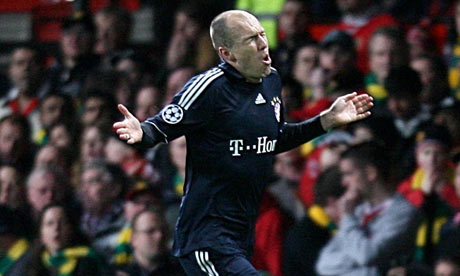
Arjen Robbens’s goal against Manchester United on Wednesday silenced not only Old Trafford, but the scores of British fans and media who have long believed that success is their divine right.

With the English stranglehold of the Champions League in recent years has come an unhealthy sense of entitlement, from players, supporters and the media. This season, however, has been a wake-up call, and the reality has been particularly hard-hitting this week.

With Arsenal and Manchester United crashing out in the quarter-finals, and Chelsea and Liverpool ejected at earlier stages, this season’s Champions League final will be the first to be contested without an English side since 2004.

And the dearth of British representation in the semi-finals has sparked a spate of unnecessary investigations into a non-existent crisis for English club football. This worry seems all the more ridiculous when one considers that both Liverpool and Fulham have reached the final four of the Europa League.

Rather than scrabble for reasons for this supposed emergency in British football, recent events should instead encourage fans and commentators to rein in their expectations, which have long since spiralled into realms of the stratospheric.

These bloated expectation levels are the manifestation of an innately British notion of entitlement, and it is this presumption of success which spawned the incredulity Manchester United fans felt after their defeat this week to Bayern Munich.

How embarrassing, they must have thought, to lose to these overachieving German upstarts. In truth, the loss should not have come as an earth-shattering surprise. Bayern are a footballing giant, with four European Cups to their name, yet the bafflement which met last week’s result suggested that they’d won with Angela Merkel in goal.


Sir Alex Ferguson could have acknowledged Bayern’s well-deserved aggregate win, but he instead accused them of foul play. “Typical Germans,” Ferguson complained, perhaps forgetting the Roy Keane-led posses which used to surround Premier League referees on a weekly basis, to United’s advantage.

More than an inability to admit to being outplayed, what this reveals is the unrealistic expectations weighing down British sport.

Earlier this year, Team GB was forced to defend its medal tally at the 2010 Winter Olympics, when Hayley Williams’ gold in the skeleton proved to be the sole success. Although this was an improvement on the one silver Team GB claimed at Turin in 2006, the knives were out for Britain’s winter Olympians.

Again, the reaction was mystifyingly hysterical. Britain, after all, does not traditionally specialise or excel in winter sports, and this is reflected financially. British snowboarding cross competitor Zoe Gillings voiced her frustrations about Team GB’s shortcomings at the games, but was also sceptical about the criticism the athletes face: “Without the funding, we’re not going to get anywhere.”

The demands for success are similarly implausible in the summer’s equivalent, even though it is widely recognised that Olympic sports trail far behind football, rugby and cricket in terms of participation, audiences and funding.

Whatever the sport, the British consider themselves to have a divine right to success. Every year at Wimbledon, Andy Murray is expected to win, regardless of other players’ form or the Scot’s own slight aversion to grass court tennis.

Similarly, whenever the football World Cup is mentioned, what immediately follows is self-righteous trumpeting of the spirit of 1966 and a series of ill-informed predictions of an England triumph. The merits of opposing teams are overlooked, and a predictable English quarter-final exit is mourned like the death of a monarch, or in The Sun’s case, seen as a global conspiracy against "our 'onest lads".

As this year’s World Cup in South Africa approaches, we have already been inundated with panic-stricken injury updates and boasts of England’s apparently inevitable success, but perhaps recent disappointments will have at least created a ripple of doubt among the sea of self-assurance.

Thursday, 25 March 2010

Cardiff City: Bigger than Barcelona?


An exasperating 1-1 home draw with Sheffield United may not represent the makings of a European superpower, but Cardiff City’s capacity to underwhelm has earned them comparisons with Barcelona and Real Madrid.

Sam Hammam’s infamous reign as Cardiff’s owner was littered with claims of being ‘bigger than Barcelona’, only for these boasts to be tempered by defeats to the mighty likes of Darlington and Bournemouth.

Hammam has since departed with a debt-ridden vapour trail in his wake, but Cardiff’s current manager, Dave Jones, has now added his voice to the unlikely correlation between the Bluebirds and the Catalan giants, claiming that expectations at Cardiff are as high as those surrounding Barcelona and Real Madrid.

And while Cardiff’s debts of £1.75m seem modest in light of Real Madrid’s summer splurge of over £200m, Jones’s association is not as incongruous as first impressions may suggest.

The historian Gwyn Alf Williams was right when he referred to Welsh people as ‘Italians in the rain’, alluding to their Mediterranean passion and emotional extremity, albeit in a rather less glamorous climate.

Although it is uncertain whether Jones is familiar with Williams’ work, the manager did seem to echo the historian’s sentiments when he said: "You lose a couple of games around this part of the world and it's as if it's all fallen apart."

As well as recognising the volatile nature of Cardiff City fans’ reactions, Jones also appears to have grasped how heavily the national mood of Wales is influenced by the fortunes of its sports teams.

The national rugby side, for example, spark a glowing sense of nationwide glee whenever they win a Six Nations Grand Slam. Parties are thrown, newspaper headlines boast of imminent world domination, and calls for a commemorative national holiday are vociferously backed at an impromptu Shakin Stevens concert staged at Cardiff Castle.

Losses to England or Italy, however, prompt deep and gloomy self-reflections, as the country slumps into a state of misery usually only applicable to a child who has excitedly opened a Christmas present, only to find a copy of Danny Dyer’s Football Foul-Ups DVD, staring blankly from the debris of wrapping paper.

The same is true of football fans, and Jones’s tongue was not quite so firmly in his cheek as one would have first thought when he said: "You have the expectation levels of Barcelona or Real Madrid-types here.”

Grumbles of discontent filled the rain-sodden Cardiff City Stadium as the home side were held by the artisan Sheffield United this week, but as the Bluebirds still occupy a play-off spot in their quest for promotion, it seems fair for Jones to think that expectations may be a little lofty.

Jones’s Spanish connection might also add another dimension to Cardiff’s upcoming derby match against Swansea – what we may now consider to be South Wales’s answer to ‘El Clasico’.

Swansea, playing in white, will at least be wearing a kit similar to Real’s, while Cardiff have a squad oozing with as much flair and panache as any Barca side. The Catalans may have Thierry Henry, but Cardiff’s attack is led by Jay Bothroyd, and Barcelona’s so-called best player in the world, Lionel Messi, is little more than a poor man’s Peter Whittingham.

When Swansea visit, the Cardiff City Stadium (a name no catchier nine months after its unveiling) will be rumbling with animosity, and perhaps in this hateful cauldron befitting of the Nou Camp, Jones’s comparison may seem a little less fanciful as South Wales’s superpowers collide.

Sunday, 7 March 2010

'Not that type of player': How football's limp excuses wear thin


Ryan Shawcross was an unassuming, quiet presence on the England bench at Wembley in midweek, a far cry from his tumultuous last appearance.

Two images defined last weekend’s football action: a tearful Shawcross leaving the Britannia Stadium pitch after being sent off for his tackle on Aaron Ramsey, whose crumpled leg was the match’s other enduring sight.

Shawcross’s manager at Stoke City, Tony Pulis, was quick to defend his player: “Ryan is not that type of lad.” This feeling was then recycled as post-match interviews mulled over the incident, and it became evident that we would hear the same old excuses.

It almost goes without saying that Shawcross didn’t mean to break Ramsey’s leg. What grates, however, is the repetitive, inane nature of the defence offered, and how, instead of taking responsibility for their reckless actions, the perpetrators are portrayed as victims.

Ramsey’s Arsenal team-mate Eduardo fell victim to a similar injury in February 2008, when a tackle from Birmingham City defender Martin Taylor left his ankle hanging by a thread.

Like Ramsey, Eduardo’s career was in jeopardy, and also like the Ramsey case, the offending player’s manager used the same limp excuse, as Alex McLeish said: "Martin's not a dirty player."

This hollow sentiment is uttered too often, and after Eduardo’s injury, Wenger said: "The worst thing you hear after is that 'he's not the kind of guy who usually does that', but you need to only kill one person one time - it's enough."

Ramsey’s injury was the third such incident in less than four years, after Abou Diaby suffered serious damage to his ankle after a terrible challenge from Sunderland’s Dan Smith. Again, the excuse offered by the offending side was feeble, as then Sunderland caretaker manager Kevin Ball said: "Dan Smith is by no means a dirty player.”

If Shawcross had caused an injury by crashing his car, Pulis is unlikely to have offered the defence: “He’s not that type of driver.” Nobody involved in a car crash purposefully drives into another vehicle, but it is to be expected when the driver responsible has their licence suspended.

In this case, then, why are footballers so reluctant to accept responsibility when they are involved in such serious incidents?

Shawcross may not have been trying to shatter Ramsey’s leg, but the horrific collision was the result of a team’s bloody-minded determination to physically unsettle technically superior opponents.

And the stomach-churning image of Ramsey’s decimated shin is not only the result of one team’s efforts to ‘get in the faces’ of the Arsenal players, but a product of a wider culture of thuggery.

As Wenger notes, these are not merely unfortunate coincidences: "It goes with the idea that to stop Arsenal you have to kick Arsenal and that kind of thing [Eduardo’s injury] was waiting to happen.”

When pundits discuss ways of beating Arsenal, they invariably mention how the Gunners “don’t like it up ‘em”, and that teams will succeed if they “get in their faces” and “stop them playing”.

This message then seeps into Premier League changing rooms, where the likes of Pulis and McLeish urge their sides to rise to the challenge in an unswervingly robust manner.

And, deliberately or not, this physical approach eventually culminates in ugly scenes such as those at the Britannia Stadium.

Published in Leeds Student on Friday, March 5, 2010
Maybe Dara O'Briain is a regular reader:
http://www.guardian.co.uk/football/blog/2010/mar/06/aaron-ramsey-broken-leg-ryan-shawcross

Friday, 29 January 2010

The graveyard shift

Whether it is a confused Spanish playmaker being shown around Birmingham or a promising Belgian midfielder taking in the sights of Wolverhampton, the January transfer window represents new beginnings for footballers.

For managers, however, the biting cold of British winter is a harbinger of change for the worse.

Sackings have been typically commonplace this winter, but what has been particularly eye-catching is the funereal manner of these dismissals.

News of Manchester City’s December sacking of Mark Hughes was broken to viewers like a state funeral. Pundits were asked to pay tribute to a “good man”, and other managers were quick to praise a fellow professional who “deserved better”.

Gary Lineker dispensed with his default mode of radiant smugness to glumly announce Sparky’s departure, and Match of the Day ended their usually chirpy closing montage with commentator Steve Wilson’s despairing mention of Hughes’ “lingering wave”.

Even Arsene Wenger, the supposed ray of intellectual hope in the landfill site of Premier League clichés, succumbed to the solemnity by adding that “it is always very sad when a manager loses his job”.

The most sombre of tributes was paid to Alan Irvine, who was fired by Preston. His successor Rob Kelly vowed that the club would “carry on as we did before – it’s what Alan would have wanted.”

He also mourned Irvine as “not just a great manager but a great person”.

Despite his morbid departure, Irvine has since found employment at Sheffield Wednesday. And judging by his immediate success at Hillsborough, Irvine’s move is proving to be a resurrection.


Paul Hart’s exit from Queen’s Park Rangers did not cause such a stir. This managerial casualty was instead brushed aside like one of many incidental fatalities in a gangster film.

The indifference should come as no surprise. Hart (pictured) was the ninth manager to be dispatched by QPR owner, Formula 1 mogul and pseudo-mafia boss, Flavio Briatore.

Wary of Briatore’s fearsome reputation, media coverage of Hart’s demise was muted. Rolling news channels were conspicuously unwilling to expand on the issue, while newspapers were similarly careful not to upset Briatore.

Similarly bereft of sentiment was the end of Gary Megson’s tenure at Bolton. Like Hart, the response to Megson’s demise was underwhelming in terms of sympathy, somewhat like the national feeling of indifference induced by the death of Bernard Manning.

Bolton fans had long been clamouring for his dismissal, and when the fateful moment arrived, it was met with the fervour usually reserved for the gallows.

Linguistically, managerial fatalism comes as no surprise. Each rumoured sacking is met with tabloid headlines and studio chatter of ‘nails in the coffin’ and ‘dead men walking’.

Some managers, such as the gloomy, vortex-eyed Avram Grant, are a step ahead of their peers, appearing to already be half dead as they morbidly prowl their technical areas.

Grant’s club, Portsmouth, have recently had a transfer embargo lifted, and they will be hoping that an influx of new faces breathes new life into the relegation-threatened side.

Amid the chaos of the transfer window’s frantic closure, the end of January at least offers a slither of hope. Spring is a not too distant prospect, and with the almost bearable climes of February, comes the realisation for managers that they may have survived the culling season.

Friday, 30 October 2009

The Football League Show Blog. Show.

The Football League has undergone numerous facelifts and rebranding projects to rid itself of old pre-cursors such as the ‘basement’ or ‘the graveyard of ambition’.

The Championship (formerly the second division) is no longer solely associated with the top division’s title chase, and League One and League Two are deceptively elevating pseudonyms for what are actually the third and fourth tiers of British football.

Whereas the Football League has been innovative with its reinventions, though, the BBC’s coverage of it has been a little less than imaginative. The catchy name for its weekly, post-Match of the Day slot? The Football League Show.

And while the BBC’s coverage, despite its less than eye-catching branding, has still increased viewing figures for the divisions in question, its peculiar underground studio does create a basement feel.


Every Saturday night, we’re taken into the depths of a cold, bare warehouse, with only presenter Manish Bhasin and an analyst, usually Steve Claridge, for company. Claridge, having played for most, if not every one, of the football clubs in the United Kingdom, is the ideal man to guide you through the efforts of Gillingham’s John Nutter or Morecambe midfielder Emmanuel Panther.

Meanwhile, another of the BBC’s (un)memorable creations is the title of its League Cup programme… The League Cup Show.

This competition has also had its image tarnished by indifferent managers and belittling media coverage but, like the Football League, it has consistently reinvented itself as, among other things, the Milk Cup, Worthington Cup and now the Carling Cup.

It may only have rebranded itself for financial reasons but attendances are up, big clubs are all taking it seriously and, judging by the BBC’s decision to call in the big guns (well, Mark Lawrenson) for its coverage, the Carling Cup appears to be in rude health.

There is viewer interactivity in both programmes, with Jacqui Oatley and Lizzie Greenwood-Hughes fielding emails from fans. Although a little tedious, it does spare us the aural ordeal of a radio phone-in ‘debate’ between Alan Green and ‘Dave from the Wirrall’.

One facet of the footballing media circus the BBC has disappointingly overlooked is Andy Townsend’s Tactics Truck, last seen on ITV’s ill-fated Premiership highlights package. The nearest thing we’re treated to is the expert Leroy Rosenior chatting excitedly about the ‘total football’ on display at, erm, Huddersfield Town.

The BBC also has coverage rights for football’s truly unfashionable competition, the Johnstone’s Paint Trophy. It remains unconfirmed, however, whether there are plans to broadcast The Johnstone’s Paint Trophy Show.


As written for Leeds Student 30/10/09

Tuesday, 1 September 2009

Window of opportunity nears chaotic closure

Ankara’s rammed Esenborga Airport was an unlikely scene of mass hysteria earlier this summer, and it wasn’t a visit from the Pope or an Elvis comeback concert that the Turkish capital was staging, but a feverish welcome for quite a different hero.

Darius Vassell may be a striker with a less than handy knack for not scoring – best known for missing a penalty in England’s Euro 2004 quarter-final exit – but, at his new home, he has been embraced like a messiah.

Described as ‘more than a player’ by Ankaragucu fans’ placards, the former Manchester City misfit looked understandably surprised as around 3,000 supporters let off flares and chanted his name.


And it is this maniacal response to new arrivals that embodies the world’s undying thirst for the circus of the transfer window, which comes to a frenzied close today.

Whether it is a Bosnian wonder-kid heralded as Man United’s new favourite son, or an unattached journeyman going through the motions at a trial match in Grimsby, football transfers capture the essence of a British summer like the sight of a binge-drinking 16-year-old girl lying face down in a puddle of gravy and vomit outside Oceana, just hours after collecting 27 A* GCSEs.

The closure of the window, however, is as much a harbinger of the summer’s end as a chilly autumnal shower, and it is accompanied by chaotic ‘wheeling and dealing’ all over the world.

As 5pm nears, tanned and bejewelled agents across Europe will be frantically trying to explain why their Lithuanian utility defender is worth a last-minute multi-million bid, while managers will jostle for the signature of an aging forward whose ‘dream’ it has always been to join an underachieving Championship club.

And our friends at Sky Sports News will be there, anticipating every routine medical or rumoured trans-continental swap deal with the sort of excitement Carlo Ancelotti feels when he enters Greggs’ bakery.

The window won’t re-open until January the first, so make the most of Sam Allardyce’s latest pursuit of a fading former ‘Galactico’, ’Arry Redknapp’s bid of £3m and a bag of chips for David James, or Phil Brown’s failure to attract a confused Argentine playmaker to Hull.

Saturday, 23 May 2009

Survival Sunday blazes a trail for football TV analogies

'Survival Sunday’. It may sound like the producers of Lost have taken control of English football for the weekend but, for idlers familiar with Sky Sports News, the phrase has become synonymous with 24.

Before any ‘exclusive’ with, say, Gareth Southgate regarding the fight for Premier League survival, we are faced with the flickering digital graphics and beeping soundtrack of the long-running action series’ opening credits.

In a week where tension has risen like Michael Martin’s blood pressure, the severity of Sky’s tone suggests that the strain of the Premier League’s final match day would overwhelm even Jack Bauer himself.

Jack Bauer: Taking aim at Alan Shearer. Maybe.


Conveniently, tomorrow will be the 24th of May, but I think the parallels should be drawn beyond this coincidence.

There should be split-screens throughout Sky’s coverage; switching from Sunderland to Hull and other relegation-threatened teams with the sound of a ticking bomb lingering in the background.

Tension will reach unbearable levels not as our protagonists look to thwart attempts on a presidential candidate’s life, but as they strive to retain Premier League status.

Hearts will miss a beat not at the sight of flying bullets but of Newcastle defenders flinging their bodies to block a scuffed shot from Emile Heskey. Jeff Stelling could even narrate.

Personnel will play an important role in replicating 24’s relentless action. Elisha Cuthbert may not be present at any of the stadia, but the Villa Park crowd will at least have the eye candy of Iain Dowie, at whom they can gaze lustily amid the chaos.

The role of sinister, serially-telephoning nemesis would be amply fulfilled by the agent Kia Joorabchian, as he plots Carlos Tevez’s next move from the directors’ box at Hull’s KC Stadium.
With 24 potentially so well represented, it’s a shame TV analogies aren’t encouraged more in football coverage.

With the bottom half bursting with adrenaline, it seems the more predictable top four would be best represented by the steadier entertainment of a cartoon. Wacky Races, which invariably begins with an exciting exchange of the lead before ending with the same victors, seems a fair illustration of a season at the Premier League’s summit.

Perhaps the struggle for mid-table bragging rights could borrow from the battle for gang supremacy in the projects of The Wire. Appointing Stringer Bell as Wigan Athletic’s chairman would certainly liven up a Monday night fixture against Bolton.

Giving teams fictional alter-egos could attract new fans as well as appease current followers. West Brom? Think of them as football’s answer to the O.C. or 90210 – aesthetically pleasing but with little beyond the attractive surface.

Fulham, meanwhile, could bolster their modest attendances by rebranding themselves as the sport’s Channel 4 News; friendly, middle class and steadily growing in stature and popularity.

Thursday, 7 May 2009

Capital capitulation

I had hoped to wake up on Monday morning to find that the previous day had all just been a bad dream.

Unfortunately, Cardiff City’s seventh place in the Championship’s final league table stared blankly at me from my computer screen, an unforgiving reminder of Sunday’s monumental collapse.

With four games left in the season, the Bluebirds had automatic promotion in their sights but wilted under the pressure to succeed like a daffodil in a blast furnace.

They mustered just one point from a possible twelve, conceded twelve goals and threw away a golden chance of becoming a Premier League club.

Dave Jones' expression is rumoured not to have changed since May the 3rd.

As I searched desperately for reasons to be cheerful – well, a possible trip to Hull next season – I tried consoling myself by thinking of sport’s other spectacular capitulations.

“I would love it!” is the infamous Kevin Keegan quote which will forever be synonymous with the 1995-96 Premier League season and, in particular, dramatic self-destruction.

Despite being 12 points clear at the top in January, a jittery run-in saw Newcastle surrender the title to Manchester United.

The Magpies never truly recovered, and now face the ignominy of joining the legion of underachievers in English football’s second tier.

Eclipsing Newcastle’s capacity to crumble under pressure is quite a feat, and one that the English cricket team has repeated on numerous occasions.

Most memorably, the second test of the 2006-07 Ashes at Adelaide signalled not only the turning point of the series but also the end of the briefest of golden eras, ‘The Class of 2005’.

Having declared on a mammoth 551-6 in the first innings, the tourists were poised to level the series at 1-1 when they were 69-1 in their second innings.

Once Andrew Strauss fell to England’s perennial tormentor Shane Warne, however, they imploded to gift Australia an unexpected win and, with it, a platform for a crushing 5-0 series triumph.

When the Ashes start in July, I’ll be in Cardiff hoping that the England and Wales Cricket Board XI can upset Australia and, in the process, spark a collapse that I can actually enjoy.

As written for Leeds Student

Wednesday, 1 April 2009

Sheepish Sky sweep Shearer's past aside

There will be an eerie silence when Gary Lineker next invites ‘expert’ analysis from the Match of the Day couch. Viewers would usually ready themselves for a cliché splurge from the BBC’s preacher of the bleeding obvious, Alan Shearer, but these insights will now be confined to the walls of St James’ Park, now that the former England striker has been appointed Newcastle manager.

This appointment seems familiar. In January 2008, Kevin Keegan was heralded as Newcastle’s ‘favourite son’, ready to restore the club to its rightful place... twelfth place in the Premier League. King Kev’s tenure, however, lasted only eight months and sparked a period of disorder and drama turbulent enough to make Jacqui Smith wince.

Having gambled and failed with a fans’ choice, club owner Mike Ashley called on Joe Kinnear and Chris Hughton before buckling once again to supporter pressure. Inevitably, Shearer has already been lauded by the Toon Army faithful as the ‘messiah’ required to save them from relegation.

With the news coming too late on Tuesday evening for the majority of newspapers, it was left to Sky Sports News to expand on the hilarity at St James’ Park.

As well as its usual bombast, how the rolling news channel really entertained was by maintaining its tradition of pretending that anything happening away from their cameras does not exist.

Formula 1, the Six Nations and autumn international rugby union are a rarity – they are sports events not covered by Sky. Therefore, it seems rational to Murdoch’s minions to view these as pure fiction and, consequently, afford them no recognition.

When looking at a chronology of Shearer’s career, the presenters became noticeably quiet as they discussed his activity after retiring. Having read one disgruntled fan’s email demanding Shearer to “go back to the screens”, the anchors mumbled inaudibly before moving swiftly on to their next Sky Sports News ‘exclusive’.

An unsuspecting first-time viewer of sports broadcasting may have wandered why such sheepish behaviour surrounded the mention of a player’s relation to television. What could these people be hiding? I’d imagine a discussion between the channel’s researchers and producers sounding a little like this:

Researcher: “At least we won’t see Shearer on Match of the Day anymore.”
Producer: “What’s that?”
R: “You know, the Premier League highlights package.”
P: “You mean Football First?”
R: “No, Match of the Day – it’s on a Saturday night on the BBC.”
P: “On the what?”

In such moods, tuning into Sky Sports News is like watching a broadcasting corporation collectively stuffing its ears with its fingers and repeating like an unrepentant schoolchild, “lalalalalalala!”

Somebody, somewhere at the BBC must be delighted. Match of the Day may now even produce a soundbite containing a semblance, however small, of interest. That is, of course, if the programme even exists.

Thursday, 19 February 2009

The Secret of Being a Good Football Team

Ask a football pundit why Arsenal are such a joy to watch and the reply will probably include a platitude about the Gunners "playing football".

It may seem nonsensical to the casual observer but, to an armchair fan hardened by seasons of rolling news channels and highlights programmes, the phrase is ubiquitous.

Studio analysts offer their wisdom with the sort of knowing confidence that suggests they are indulging us in information so precious and rare that it requires its own conservational charity.

Pundits appear to see themselves as tactical philanthropists, seemingly saying: “To all of you languishing in relegation battles, take note – it is by ‘playing football’ that you become successful.”

A team's decision to do so is often met with pleasant surprise from analysts. It is with some relief that a perma-tanned former pro will say, "Well, Gary, it's great to see a team come out and play football."

Are we missing something? It could be that the average viewer is unaware of a preceding fixture, where Bolton have visited Old Trafford with helmets and pads to counter the threat of Cristiano Ronaldo with an American football blitz defence.

Considering that their work entails nothing but watching the sport, it can seem confusing that pundits cherish a side’s decision to “play football” with the apparent glee of an art critic who has stumbled upon Wayne Rooney reciting a soliloquy from Hamlet.

Teams with the audacity to "play football" should be warned, though. West Brom have suffered for such a philosophy, as their 4-0 and 5-0 losses to Man United apparently came from being too open and "playing too much football". Tony Mowbray seems to have much to learn about the Premier League if he thinks that playing football will yield success in a football match.

Meanwhile, the highest compliment Australia cricket captain Ricky Ponting can pay is that his opponents have, "played some really good Test cricket." As he rattles through his post-match pleasantries, one can imagine his players breathing a sigh of relief in the changing rooms, "Jeez, those Poms played some great cricket today – much tougher than when they had their table tennis bats."

It would appear that the secret is out. While footballers grasp that “playing football” is the foundation for success, even cricket teams have embraced the idea of “playing cricket”. And if the eventual 6 Nations champions will point to “playing rugby” as the key to their triumph, then they will have the besuited and tanned of Soccer Saturday and Match of the Day to thank.

As written for Leeds Student, February 20, 2009

Monday, 4 August 2008

The New Season Checklist

With another season almost upon us, here is a reference point to the key components of a Premier League year.

See how many you can spot, and how quickly you can do so...

1. An Alan Hansen sentence made entirely of listed attributes. Bonus points for nonchalant delivery or contemptuous tone.

E.g "Power, pace, aggression, strength, control... just great."

2. Exotic foreign signing to proclaim it a realisation of a long-standing ambition to join newly-promoted Premier League side.

"It has always been my dream to play for Hull. I can't wait to play alongside my hero... Dean Windass."

3. Aforementioned exotic foreign signing to make 'come-and-get-me-plea' to an underachieving Serie A side by January.

4. Joe Barton to be arrested.

5. Lee Dixon noting that an unfancied side's win is almost entirely a result of their closing down. At no point, should a side supposedly famed for physical strength be lauded for flair or skill.

"Bolton did really well today, they really got in (insert 'big four' team) 's faces. They closed them down, and didn't let them play."

6. New, groundbreakingly expensive Champions League side recruit makes flying start, putting Wigan to the sword in a second substitute appearance.

7. Said player fades from September onwards but roars back to form by bundling in a late second goal to ease nerves in January cup tie against League Two opposition.

8. Sky Sports News to 'exclusively reveal,' every eleven minutes, that Phil Neville has a sore foot.

9. Supporter, player or manager of relegation-threatened team to claim that "every match will be a cup final." Kevin Campbell-styled motivational speech ("If you don't believe, you won't achieve!") optional.

10. A radiantly orange Gary Lineker to sign off an episode of Match of the Day with a smugly sarcastic quip, apparently dispelling the notion that the top four placings can be predictable.

"Just another typically boring 15-goal thriller, then. Good night."

Thursday, 10 July 2008

The Blathering Blatter

The footballing summer seemed too good to be true. After a refreshingly expansive and entertaining major international tournament in Euro 2008 and, by its usually insufferably hyperbolic standards, a reasonably quiet rumour mill, something had to give. Step forward, Sepp Blatter.

In the latest in a long line of idiotic soundbites, Blatter has spoken about one of the transfer sagas churned out by the aforementioned mill. Referring to the tiresome tug of war for Cristiano Ronaldo between Manchester United and Real Madrid, the FIFA president claimed, "There's too much modern slavery, in transferring players or buying players. We are trying now to intervene in such cases.'' In Blatter's case, this is one intervention too far.

With a string of foolish quotes to his name, the Swiss is as much a subject of light-hearted ridicule as real criticism, but in this instance, his comments have pushed the boundaries of taste. Even those who work closely with Blatter have been quick to condemn his views, such as Uefa's communications director, William Gaillard,"It would be useful to remind people that slaves in all of the slavery systems never earned a wage." The incongruity of mentioning slavery's iniquity in the same breath as poor old, £100,000+ a week Ronaldo, is staggering.

Gaillard highlights the lack of sensitivity in Blatter's brash proclamations. For a man of such stature, it is irresponsible, if not plain stupid, to throw about terms that bear such painful significance with seemingly contemptuous disregard.

Not only is the 'slavery' quote grossly inappropriate, it is entirely missing the point that, in fact, it is players who hold the power in today's market. The Andy Webster ruling (where a player can buy out his contract in order to leave) has rendered contracts almost meaningless. Even if such a move proves too costly for a player, an agent's close proximity to endless media sources makes the now customary 'come-and-get-me-plea' an immediate, and effective, way of attracting suitors.

Blatter is a man whose ridiculous outbursts have often been ignored as the silly ramblings of a political eccentric. Quota plans contradictory to EU constitutional laws and a supposedly corrupt reinstatement were swiftly brushed under the carpet. Most infamous, though, was his view that women should "wear tighter shorts" to promote the female game, though this was largely laughed off, much to the chagrin of the undermined players.

Such easy forgiveness is worryingly similar to the slack that has been afforded to Boris Johnson (as Charlie Brooker points out http://www.guardian.co.uk/commentisfree/2008/apr/14/charliebrooker.boris). Blatter's handling of world football's public relations are as sound as Johnson's relationship with Liverpudlians, yet he has somehow been appointed for a third term at FIFA's helm.

Reservations about the London Mayor should be held in the same way about the out-of-touch football chief. If Blatter chooses to lament the game's state in his uniquely ill-informed manner, it should be his own position and running of the sport that should come under serious consideration.

Friday, 27 June 2008

Shattered Myths and Silenced Pundits

Having overcome a tenacious Turkish effort to progress to the final of Euro 2008, Germany’s pulsating 3-2 success belied the sombre mood in the Match of the Day studio, which suggested the win was a dull miscarriage of justice. “Lucky, lucky Germany?” Gary Lineker lazily asked a typically uninspiring Alan Shearer, whose response was myopic and cliché-ridden, “Aye, they’re a very average side... at the end of the day, they’ve just done enough.”

At times, Shearer contradicted himself as he confused the tired, now unfounded, notion that German success is traditionally a product of “good, solid organisation” at the back, with his belief that this current crop were a “very poor” defensive outfit. Yet, despite the evident difference between the two thoughts, the former beneficiary of defensive mishaps seemed to believe that this ‘shambles’ of a team was actually a perfect example of a structured German fluke. Undermined by his own paradoxical analysis, Shearer was seemingly blind to see that, despite their defensive misgivings, Germany had stormed to victory in a five-goal thriller for the second time in a week.

Clearly rattled by the early Turkish onslaught, it was a joy to see Germany respond with a fine counter-attacking goal, almost a carbon copy of their clinical opener against Portugal. As Bastian Schweinsteiger deftly turned the ball beyond Rustu’s grasp, here were the “average” side shattering their dour reputation with some über-thrilling football. Furthermore, Philipp Lahm’s excellent late strike, just one of this tournament’s many memorable German goals, gave the match a fittingly explosive climax.

Bold and direct, Turkey gave their illustrious opponents a thorough, sometimes torrid, examination. Colin Kazim-Richards (whose full name, the BBC would have you believe, is ‘Colin Kazim-Richards-Formerly-of-Bury-Brighton-and-Sheffield-United’) was a particular thorn in Germany’s side. The forward’s incessantly-mentioned English background is just one example of the shameless way in which the BBC’s patronising coverage hasn’t allowed a single match to pass without a British reference.

Whether it has been “Kuyt of Liverpool” giving Holland the lead against France, or “Andreas ‘The Austrian David Beckham’ Ivanschitz” spraying the ball profligately, John Motson has found countless opportunities to yelp with delight about this competition’s increasingly tenuous connections to Dear Old Blighty. Did you, by any chance, know that Italian midfielder Simone Perrotta was born in Ashton-under-Lyne, the very same birthplace as Geoff Hurst? Yes we did, John – you told us four minutes ago.

The verve of Turkey’s performance should not diminish the excellence of Germany’s march to the final. Vivacious in their dispatching of Poland and driven as they prospered in a tense encounter with arch-rivals Austria, their progress in the group stages was both entertaining and testament to their unyielding passion. Moreover, their high-octane 3-2 victory over Portugal was the pick of the quarter-finals, and their semi-final triumph of the same score line demonstrated how the Germans have produced some of Euro 2008’s most exhilarating moments.

Firing them forward has been the front four of Podolski, Ballack, Schweinsteiger and Klose, the attacking nucleus of an enterprising side. Boasting nine goals between them, the quartet have combined to devastating effect, with Ballack, in particular, imperiously dictating proceedings. The 2006 World Cup laid a foundation for such entertainment, as Jurgen Klinsmann’s semi-finalists notched eleven goals in their first four matches. At the time of writing, only Spain have scored more goals (11 to their 10) during this tournament, which offers further evidence to disprove the stale concept that Germany can only grind out narrow wins, dependant on their so-called miserly and rigid defence.

Contrary to popular (or punditry) belief, such exciting talent is neither new nor revelatory for a country that has produced some of the game’s most mesmerising stars, like Günter Netzer and Bernd Schuster. If only to silence dubiously tanned doubters, come Sunday evening, this year’s vintage can hopefully serve up another spectacle and join the illustrious line of German greats.